Skip to content
Portrait of Ilmari Vuorenmaa.

AI and technology architect

AI inside the process.Quality gates around it.

AI and technology architect, ten years across international projects, presales and platform ownership. C-level strategy in the morning, the integration ticket in the afternoon. I turn complex delivery problems into measurable business impact, then scale what works.

strengths

Four things I bring to an AI architect's work. Each one links to where it can be seen.

  1. AI inside a process, with quality gates

    A language model does not decide alone. One model writes, a second reviews what the first is unsure of, and strict rules or ordinary code decide what may be shown.

    Product data enrichment →

  2. Data and integrations underneath

    The quality of the output depends on the context. My background is getting data from the systems that hold it to where it is used, at the right time and in the right format.

    CV →

  3. From strategy to the working system

    C-level strategy in the morning, the integration ticket in the afternoon. I start with a vision, then a roadmap, then a working system or process.

    How I build →

  4. Labelled evidence, and cost as part of the design

    Every result says how sure I am of it. What the AI costs is designed in and measured, about a quarter of a cent a recipe in liesi Measured and about €0.003 a conversation in Intently Estimated.

    liesi →

How sure am I? Every result and estimate carries one of these labels.
Measured
A number that was measured, in production or in a test.
Estimated
My best estimate, with the reasoning shown.
Hypothesis
What I expect to happen. Not proven yet.
Illustrative example
Made up to show how it works. Not real output.

work

Cases from my professional work. Each is a process I designed and built, with AI inside the process and quality gates around it.

  • Professional

    Product data enrichment

    Platform architect. I designed and built the process.

    At a global manufacturing company, I designed and built a process that writes consistent product names for a large spare parts catalogue in 11 languages.

    Read the case: Product data enrichment →

    • 11

      languages, with one consistent way to name a part

    • about 2%

      of the names go to the second model for a review Measured

    • about 4

      person-months if it were done by hand Estimated

    1. Tier 1

      Gemini writes the name

    2. Tier 2

      Claude Sonnet reviews

    3. Tier 3

      Strict rules decide

    Under the hood: Product data enrichment

    How it works

    1. Tier 1

      Gemini writes the name

      Understands the part, writes a new English name, and translates it into the other languages. Its confidence is measured and reported.

    2. Tier 2

      Claude Sonnet reviews

      Takes the names where confidence is low, about 2% of all Measured, and reasons more deeply about what the part is.

      All other names go straight to the rules.

    3. Tier 3

      Strict rules decide

      The name has to pass a set of rules. If a supplier's name would be shown, for example, the name is rejected.

    • Pass: The name is accepted.
    • Fail: The name goes back to the queue, with the reason.
    • Always: Reporting watches for failures, inconsistencies and categories that look wrong.
    How a name is written and checked.
  • Professional

    Localisation testing

    Platform architect. I designed and built the process.

    At a global manufacturing company, I built a process that tests the translations of a web shop in 11 languages and 14 locales.

    Read the case: Localisation testing →

    • 14

      locales in 11 languages, every text compared with its intended value

    • about 13 days

      of testing by hand becomes a couple of days Estimated

    1. Part 1

      A crawler

    2. Part 2

      A quality gate

    3. Result

      A report

    Under the hood: Localisation testing

    How it works

    1. Part 1

      A crawler

      It goes through the new web shop, builds the key and value pairs for each language, and maps them against the intended values.

    2. Part 2

      A quality gate

      Claude checks whether it agrees that the value used in the text is the right one.

    3. Result

      A report

      How well the new solution is translated, with a list of recommended changes for styling, tone and translations.

    How the translations are tested.

builds

Products I built myself with Claude. One shops by situation instead of by category, the other walks you through a recipe one small step at a time.

  • Own buildPrototype

    Intently

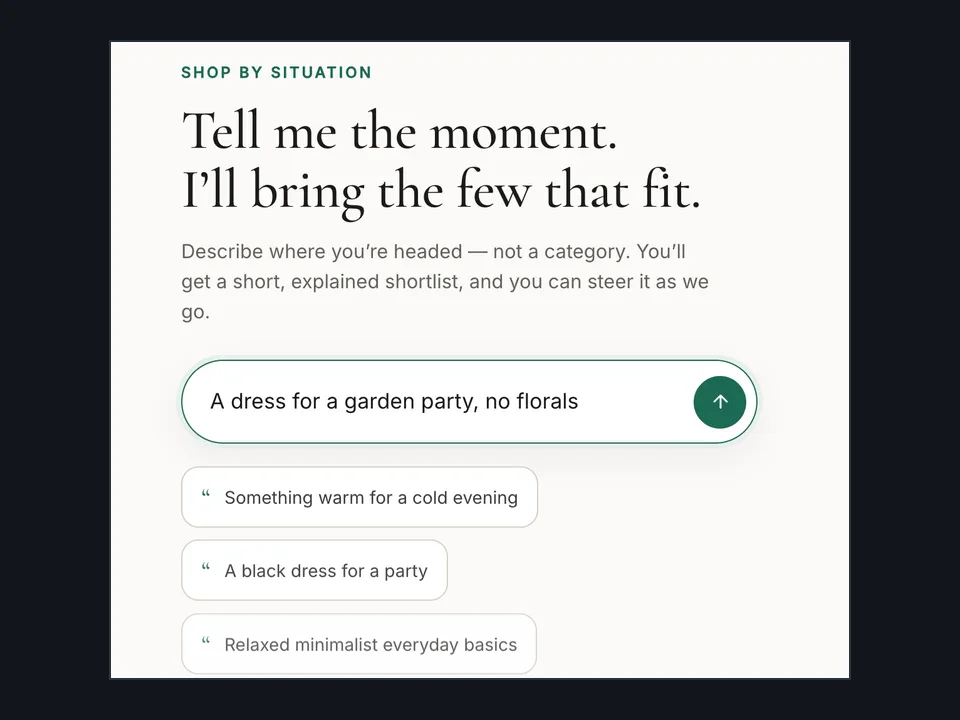
    People shop for a situation, not a category. I built a working system that answers the situation and explains its picks.

    See the build: Intently →

    • 12 of 12

      tested briefs that the parser understood kept their stated exclusions, such as "no florals" Measured

    • about €0.003

      of AI for one conversation Estimated

    • Every AI step

      is optional: without a key the whole product still works

    A short loop of three Intently screens. A shopper describes a dress for a garden party, the conversation shows what it understood, and the Studio is used to correct one attribute of a product.
    Under the hood: Intently

    How it works

    Intently architecture. A shopper's sentence passes guardrails, a parser and a complexity gate; an optional language-model step reads hard phrasing; code merges, retrieves, ranks with hard exclusions and composes a shortlist; an optional language-model step rewords it and a grounding check rejects anything not shown. Product understanding is built offline from photos. Green: code that decides. Amber: language model, words only.
    How a sentence becomes a shortlist
  • Own buildBeta

    liesi

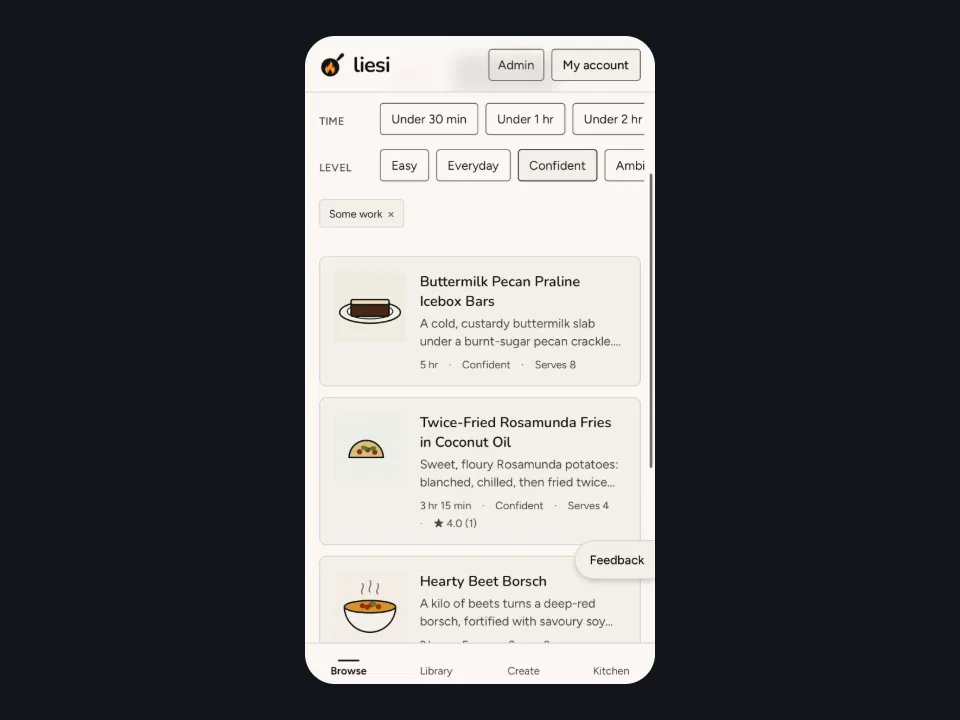
    liesi is my cooking companion app. You write recipes with AI models, then cook them one small step at a time from a phone or tablet.

    See the build: liesi →

    • about 6 weeks

      from the first commit to beta testing, in my free time Measured

    • about ¼ cent

      of AI for one recipe Measured

    • 5 models

      wrote the same dish, and I read every recipe before choosing one

    A short loop of three liesi screens on a phone. A list of recipes to browse, a form where the dish is described in words, and one cooking step with a timer.
    Under the hood: liesi

    How it works

    1. Step 1

      The model writes

      It fills in a schema, a form for the recipe: ingredients, steps, timers and what each step uses.

    2. Step 2

      A validator checks

      It checks the arithmetic and the structure in code, with no model involved.

    3. Step 3

      A craft score

      It is scored separately, from 0 to 1, to catch recipes that pass every rule but are not worth cooking from.

    • Pass: It is shown as a draft to read, change and save.
    • Fail: It goes back to the model once, with the reasons. If it still fails, the draft is shown with the problems marked.
    • Always: A generated recipe is a private draft until it is published on purpose.
    How a recipe is written and checked.

what i build

Come to me when your core data is working against you. I come in when it is unclear what the data tells, how it can be used and how to turn it into actions that create value for your customers. I start with a vision, then a roadmap, then a working system or process, as tangible as anything in IT can be.

My strong points are data, integrations, making sense of the data, and processes of many kinds, simplified to what matters. They are not tied to one industry: I have worked with them in finance, retail, manufacturing among others.

  • Data management. Making sense of large amounts of data and keeping it consistent, such as consistent product names for a large spare parts catalogue in 11 languages, or retail forecasting on millions of rows of input data a day (CV).
  • Integrations. Getting data from the systems that hold it to where it is used, at the right time and in the right format: from an ERP system to a web shop, or through an API for fund subscriptions and redemptions at a bank (CV).
  • Process modelling and development. Finding the process that matters and making it simpler, such as testing the translations of a web shop in 11 languages, or a paper-based onboarding process turned into a web app (CV).
  • AI-driven innovation. AI where it earns its place: inside a process with quality gates around it, or as a new product. liesi went from the first commit to beta testing, and Intently is a working prototype for shopping by situation.

Get in touch and I'll help to analyse the situation.

Is your core data working against you? Tell me what it is doing.

Email →

how i build

I'm a generalist with a wide range of experience: many industries, platforms, technologies and countries. I look at a problem from many angles, split it into chunks of work, and then do that work.

Read more →